Beyond the Résumé: Why Hiring for Potential Is the Smartest Talent Strategy You're Not Using
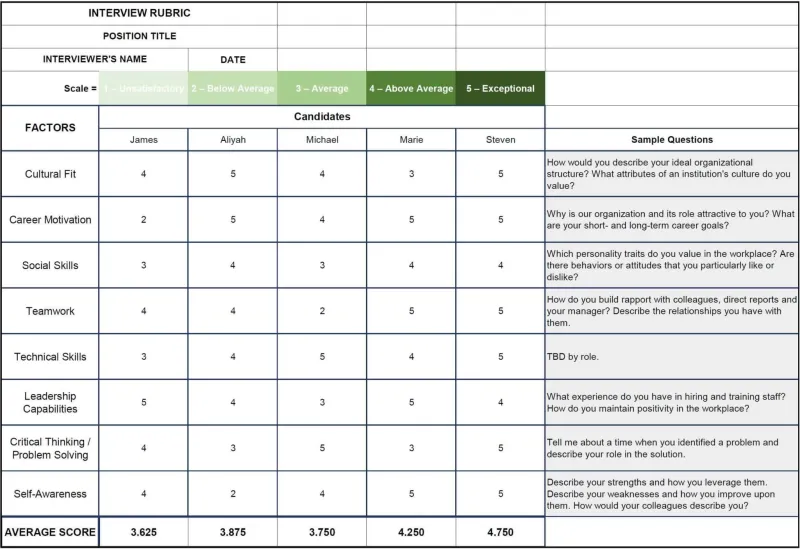
Photo: professional candidate interview assessment potential growth business, via toggl.com
There is a quiet contradiction at the heart of modern hiring. Companies declare, in their annual reports and employer branding campaigns, that people are their greatest asset. Then they hand a job requisition to a hiring manager, and the first thing that manager does is filter out everyone who hasn't already done the exact job being posted.
The logic feels safe. It is, in practice, deeply limiting.
Across industries—from financial services in New York to manufacturing corridors in the Midwest to technology firms along both coasts—organizations are discovering that their relentless focus on demonstrated, measurable skills is quietly strangling the very pipelines they depend on. The candidates who could grow into their most critical roles are being screened out before a single conversation takes place.
This is the skills obsession problem. And it is costing American employers far more than they realize.
How Skill-Matching Became the Default—and Why It's Failing
The rise of applicant tracking systems in the early 2000s accelerated a shift that was already underway: hiring became a pattern-matching exercise. Recruiters and algorithms alike began scanning for specific keywords, certifications, and prior job titles. The underlying assumption was rational enough—if someone has done a thing before, they can do it again.
But that assumption carries a hidden cost. It systematically favors the already-experienced over the genuinely capable. It rewards proximity to opportunity—those who had access to the right companies, the right internships, the right zip codes—over intellectual horsepower or adaptive capacity. And it creates a feedback loop in which organizations keep hiring the same profiles, achieving the same results, and wondering why their workforce isn't evolving.
The research is instructive here. McKinsey & Company has found that potential—defined as the combination of curiosity, insight, determination, and engagement—is a stronger predictor of long-term performance than prior experience in many knowledge-work roles. Yet most American hiring processes are not designed to surface it.
What Potential-Based Hiring Actually Means
Potential-based hiring is not a euphemism for lowering standards. That distinction matters enormously, and it is frequently misunderstood.
Hiring for potential means identifying candidates who possess the foundational cognitive and behavioral attributes that allow them to acquire new competencies quickly, adapt to changing conditions, and perform at a high level in roles they have not held before. It is, in many respects, a more rigorous form of evaluation—not a more lenient one.
The attributes that talent professionals are increasingly prioritizing include:
Learning velocity — the speed and efficiency with which a candidate absorbs new information and translates it into practical application. This is often surfaced through structured interviews that probe how candidates have taught themselves something challenging, how they've recovered from professional missteps, and how they process feedback.
Coachability — a genuine openness to correction and redirection, distinct from simple agreeableness. Coachable candidates demonstrate intellectual humility without passivity. They can distinguish between criticism of their work and criticism of their identity.
First-principles reasoning — the capacity to deconstruct a problem to its essential components and rebuild a solution from the ground up, rather than defaulting to familiar templates. This attribute is particularly valuable in roles where the business environment shifts faster than experience can keep pace.
Intrinsic motivation — the internal drive that sustains performance independent of external reward structures. Candidates who are genuinely curious about the domain they're entering tend to outperform those who are simply pursuing compensation or title.
None of these attributes appear on a résumé. All of them can be assessed—if organizations are willing to build the infrastructure to do so.
The Organizational Structures That Make This Work
Transitioning toward potential-based hiring is not simply a matter of telling hiring managers to "look beyond the résumé." That instruction, absent structural support, produces inconsistency and bias. The shift requires deliberate architectural changes at the process level.
Rewritten job descriptions. Most job postings are written as inventories of prior experience rather than portraits of future performance. Potential-based hiring begins with describing what success looks like in the role—the outcomes, the decisions, the challenges—rather than listing the credentials assumed to produce it. When organizations articulate the job in terms of what someone will do rather than what they have done, they naturally attract a broader and more diverse candidate pool.
Structured behavioral and situational assessments. Unstructured interviews are notoriously poor predictors of job performance. Organizations that hire for potential invest in interview frameworks that surface learning agility and reasoning capacity through scenario-based questions, problem-solving exercises, and deliberate probes into how candidates have navigated unfamiliar territory. These assessments should be standardized enough to enable fair comparison across candidates, while remaining flexible enough to explore genuinely revealing responses.
Internal growth architecture. Potential-based hiring only works sustainably when it is paired with a robust internal development infrastructure. Organizations that bring in high-potential candidates without a clear path to mentorship, skill development, and role progression will experience attrition—and will rightfully earn it. The employment value proposition must include a credible commitment to growth, not just an aspiration toward it.
Manager enablement. Perhaps the most underestimated component. Hiring managers who have spent careers evaluating candidates through an experience-first lens will not naturally recalibrate without guidance. Training managers to recognize and articulate potential—and to distinguish it from mere likability or cultural familiarity—is an essential investment.
The Competitive Advantage Hidden in Plain Sight
There is a meaningful first-mover opportunity in this space that relatively few American employers have captured.
Organizations that develop genuine competency in identifying and developing high-potential talent are not simply improving their hiring outcomes in isolation. They are accessing a segment of the labor market that their competitors are actively ignoring. They are building workforce resilience, because employees hired for their capacity to grow are better equipped to navigate role evolution than those hired for a specific skill set that may depreciate over time. And they are, in many cases, building more diverse teams—because potential is more equitably distributed across demographic groups than access to elite employers and prestigious credentials.
The companies that will define talent leadership over the next decade are not those with the most sophisticated applicant tracking systems or the most aggressive compensation packages. They are the ones that learn to see capability where others see absence of experience.
A Different Kind of Talent Partnership
At BGHR Recruitment, we work with employers who are serious about building workforces that endure—not just filling roles that are open today. Potential-based hiring is not a trend. It is a structural response to a labor market that is changing faster than traditional hiring models can accommodate.
The organizations that are willing to ask a harder question—not "has this person done this before?" but "can this person become exceptional at this?"—are the ones building the pipelines that will sustain them through the talent challenges ahead.
The résumé is a record of the past. The future belongs to organizations with the discernment to look further.